 I just love this brilliant little book as it reminds us of the importance of acknowledging soft skills in children. A must read for anyone wanting to move their school from behaviour management to values-based learning. See the good in everyone, in many dimensions and the rest will follow. . .
Friday, 7 December 2012
A covenant for our children - thoughts
I just love this brilliant little book as it reminds us of the importance of acknowledging soft skills in children. A must read for anyone wanting to move their school from behaviour management to values-based learning. See the good in everyone, in many dimensions and the rest will follow. . .


The art of noticing
Research carried out by the Childhood Wellbeing Research Centre shows a clear link between emotional wellbeing and educational attainment. You'd expect this to be the case and to be frank hope it to be true too. Nobody wants to live in a world where success is underpinned by unhappiness.
However dig into the report a little and it unearths some interesting findings - such as. . .
"Children with SEN who engage in awkward behaviour (e.g., blame others for
mistakes, throw tantrums) make greater academic progress from Key Stage 1 to
Key Stage 2 than children who do not engage in awkward behaviour."
In other words if things are stacked against you the best policy is not to comply; you may risk becoming invisible.
Does this mean the 'Class clown' has the last laugh? Well perhaps, but only if we give such bland reward to compliance as defining children as 'Middle Ground child' or 'always' children. True there is only one cake to go around but these findings challenge educators to find more effective ways of giving really rewarding attention to the children in the middle of the bell curve.
Friday, 30 November 2012
Child Development

"Hi Sir, I'm Tommy. I'm a 4c boy" What can you say to that! Then often the next sentence goes on to explain what they are aiming for. . . "I'm on target to be a 4a" which is wonderful to hear, but often comes with no understanding of what the number means. I even once heard a child say that they had exceeded their potential. I was too professional to suggest that the child had more potential than their teacher had thought. . . As if anyone knows just what any child can become. I'm sidetracking a bit there, so back to the shoes.
The thought of hiring a foot tutor to hot-house his foot development was the last thing on my mind. My job is to back off and let him be. Let the feet grow at their own pace! Not to say this is a cop-out; far from it. My responsibility is to ensure every opportunity for play, rest, sleep, a healthy diet and the rest of it.
Which makes me wonder, at what point do things change. . . . and what would happen if the non-judgemental nature of early child development simply continued and continued our education system. Just what would be possible I wonder?
Thursday, 29 November 2012
A covenant for our children. Let's make it happen
It's been an interesting week with some exciting projects moving forward, and all cultivated from the bottom up. It seems to me that there is an energy for innovation outside of structures of authority, and creativity is happening despite the system. Then Richard Gerver's latest blog popped into my inbox and neatly summarised this feeling.
The content chimed so loudly with my experiences of crushing bureaucracy and death-by-measurement whilst working for a local authority and has affirmed my decision to leave and go it alone. It was so refreshing to be reminded that there are many voices out there articulating the essence of what learning and education is all about. I want to send my children to a place where they are seen for the good that they are and their natural curiosities, energy and enthusiasm nurtured by adults who care deeply and genuinely enjoy the wonderful uncertainties that come with giving children space to be.
I'd encourage people to read, share and take whatever action they can to make this happen. It seems at least here in the UK our politicians are reducing children to mere statistics and notably taking the F (families) out of the Department for Children, Schools and Families. How insulting to every parent to imply that their children's learning happens exclusively in a classroom and is measured by an end of year exam! And how conveniently off-the-hook for the very small minority of parents who should be doing more to support their children. I think that's what you might call a lose-lose strategy. . .
The content chimed so loudly with my experiences of crushing bureaucracy and death-by-measurement whilst working for a local authority and has affirmed my decision to leave and go it alone. It was so refreshing to be reminded that there are many voices out there articulating the essence of what learning and education is all about. I want to send my children to a place where they are seen for the good that they are and their natural curiosities, energy and enthusiasm nurtured by adults who care deeply and genuinely enjoy the wonderful uncertainties that come with giving children space to be.
I'd encourage people to read, share and take whatever action they can to make this happen. It seems at least here in the UK our politicians are reducing children to mere statistics and notably taking the F (families) out of the Department for Children, Schools and Families. How insulting to every parent to imply that their children's learning happens exclusively in a classroom and is measured by an end of year exam! And how conveniently off-the-hook for the very small minority of parents who should be doing more to support their children. I think that's what you might call a lose-lose strategy. . .
Tuesday, 6 November 2012
Movember !
Not particularly a current news item but since it's Movember I thought it would have some relevance (and the BBC Sports Personality of the year upon us)
So David Lloyd 'advises' Murray to smarten up his image, reckoning that getting a shave and looking more like the respectable Roger Federer will somehow have some psychological advantage over the likes of Nadal and Djokovic.
I can remember watching David Lloyd play when I was a kid. Let's just say he wasn't the player I ever tried to emulate. When you're a seven year old kid you have the common sense to copy the best in the game; the players that make your hairs stand on end and all that.
For the record here's David's Grand Slam record, just so we can see why he's now one of the most powerful people in British tennis infrastructure.
Murray's Deadpan response puts it so well I thought; we are all entitled to our opinion but just because you are given a platform doesn't mean anyone has to listen to you.
Murray also refers to Bjorn Borg in his response, who as I can remember donned a beard and unlike Lloyd, had not only incredible athletic and technical ability but superhuman mental strength.
So in this month of Movember and all the perspective that campaign brings to the relative importance of male image and grooming, I take my hat off to Andy Murray for his dignified refusal to smarten up and fit in with the establishment. Sports Personality of the Year? Bradley Wiggins might have a few words to say about that. Now there would be an interesting doubles team. What with Mr Wiggins talking about a sport switch for the 2016 Olympics. . .
So David Lloyd 'advises' Murray to smarten up his image, reckoning that getting a shave and looking more like the respectable Roger Federer will somehow have some psychological advantage over the likes of Nadal and Djokovic.
I can remember watching David Lloyd play when I was a kid. Let's just say he wasn't the player I ever tried to emulate. When you're a seven year old kid you have the common sense to copy the best in the game; the players that make your hairs stand on end and all that.
For the record here's David's Grand Slam record, just so we can see why he's now one of the most powerful people in British tennis infrastructure.
| Grand Slam Singles results | |
|---|---|
| Australian Open | - |
| French Open | 1R (1968-1973) |
| Wimbledon | 3R (1968) |
| US Open | 1R (1969) |
Murray's Deadpan response puts it so well I thought; we are all entitled to our opinion but just because you are given a platform doesn't mean anyone has to listen to you.
Murray also refers to Bjorn Borg in his response, who as I can remember donned a beard and unlike Lloyd, had not only incredible athletic and technical ability but superhuman mental strength.
So in this month of Movember and all the perspective that campaign brings to the relative importance of male image and grooming, I take my hat off to Andy Murray for his dignified refusal to smarten up and fit in with the establishment. Sports Personality of the Year? Bradley Wiggins might have a few words to say about that. Now there would be an interesting doubles team. What with Mr Wiggins talking about a sport switch for the 2016 Olympics. . .
Thursday, 1 November 2012
From 11mins into this talk I began to wonder if empathy, once understood intellectually, can become an acidic tool used to destroy others from a perceived position of friendship and understanding. Just like a hammer, the ability to empathise is merely a tool. Neutral in that it cares not what it is used for. Used to listen and to heal and to give hope is one thing, but used to pretend to be a consul whilst appropriating the power that comes from emotional trust is altogether another.
Check the clip and consider the motivations of Jaron Lanier in his work. As Noam Chomsky articulates, we are in a time of huge flux and opportunity in learning that we have a choice between compliance and enlightenment. A lot is written at the moment about finding the answers from the kids. I agree. But I also think we should take the time to ask the other cohort who play outside the labour market what they do for kicks. . . .the over 65 yr olds might just have a few things to say about learning beyond monetisation as much as a child will.
Check the clip and consider the motivations of Jaron Lanier in his work. As Noam Chomsky articulates, we are in a time of huge flux and opportunity in learning that we have a choice between compliance and enlightenment. A lot is written at the moment about finding the answers from the kids. I agree. But I also think we should take the time to ask the other cohort who play outside the labour market what they do for kicks. . . .the over 65 yr olds might just have a few things to say about learning beyond monetisation as much as a child will.
Wednesday, 31 October 2012
Share good news. It helps the learning
Thanks to Robbie and Eleanor for letting me know about the program. You make the world go round.
Credit where credit is due
This is the first two-for-the-price-of-one posts. I hope it stitches together okay. I was going to post first with a suggestion for clubs considering Wonga as shirt sponsors (Newcastle FC next year. Currently Hearts and Blackpool have deals).
Plenty has been written on the moral repulsion towards pay day loans and the like, with counter arguments from the pragmatists who argue that people who live in poverty will fall prey to loan sharks of a different kind anyway. All I'd like to add is a suggestion for any club considering joining the afore mentioned outfits:
Why not take the money and slice off a sizeable proportion to fund schools in your fanbase community. The cash could fund specific work to help every pupil develop a clear understanding of what x% APR actually means and how to make smart choices by asking the questions the loans companies don't want you to ask. Then again they could spend the money and develop a credit union. Or both. . .

Which kind of brings me to the second half of this post. Whilst Wonga.com might have some clever spin-ads they kind of are who they say they are. Unlike the TES (Times educational Supplement) who position themselves as the great champions of teaching and learning. Their latest great idea is to provide a 'service' by taking professional's ideas and making them available to other teachers through their website. Sounds simple enough until you hear about things like this.
There's a lot of rhetoric around these days about creativity and the importance of nurturing ideas in our young people through an education system that recognises we are schooling kids for jobs that haven't even been imagined and to solve problems that we don't yet realise we've created. All well and good, but we need to be honest with our children. If their ideas, and those of teachers as above, are going to be appropriated by large organisations under slightly false pretences then it might just sound like a mixed message. Or very devious. Instead shouldn't these ideas be supported in ways that take pride in acknowledging intellectual property and authorship, rather than throwing a net over them as if to make out that the net-thrower now has rights to them.
As the old saying goes, what goes around comes around. So let's set an example by giving credit where credit is due.
Plenty has been written on the moral repulsion towards pay day loans and the like, with counter arguments from the pragmatists who argue that people who live in poverty will fall prey to loan sharks of a different kind anyway. All I'd like to add is a suggestion for any club considering joining the afore mentioned outfits:
Why not take the money and slice off a sizeable proportion to fund schools in your fanbase community. The cash could fund specific work to help every pupil develop a clear understanding of what x% APR actually means and how to make smart choices by asking the questions the loans companies don't want you to ask. Then again they could spend the money and develop a credit union. Or both. . .

Which kind of brings me to the second half of this post. Whilst Wonga.com might have some clever spin-ads they kind of are who they say they are. Unlike the TES (Times educational Supplement) who position themselves as the great champions of teaching and learning. Their latest great idea is to provide a 'service' by taking professional's ideas and making them available to other teachers through their website. Sounds simple enough until you hear about things like this.
There's a lot of rhetoric around these days about creativity and the importance of nurturing ideas in our young people through an education system that recognises we are schooling kids for jobs that haven't even been imagined and to solve problems that we don't yet realise we've created. All well and good, but we need to be honest with our children. If their ideas, and those of teachers as above, are going to be appropriated by large organisations under slightly false pretences then it might just sound like a mixed message. Or very devious. Instead shouldn't these ideas be supported in ways that take pride in acknowledging intellectual property and authorship, rather than throwing a net over them as if to make out that the net-thrower now has rights to them.
As the old saying goes, what goes around comes around. So let's set an example by giving credit where credit is due.
Sunday, 28 October 2012
Passion wins through
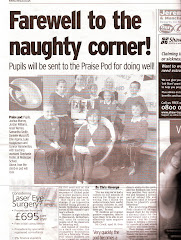
Congratulations to all the winners and runners up at this year's Pearson teacher awards. It's geat to see a new category for use of technology - well done Ben Tipton from Sacred Heart RC Primary school for having the energy and passion to inspire young minds whilst becoming a dad. I'm sure Ben will be sent to the Praise Pod after the half term break!
It was also good to see a mention for 'Teach First' too. Having met several cohorts of dedicated staff at Sheffield Hallam University I could really feel their passion and commitment shining through. Our children are in good hands.
It was also good to see a mention for 'Teach First' too. Having met several cohorts of dedicated staff at Sheffield Hallam University I could really feel their passion and commitment shining through. Our children are in good hands.
Friday, 19 October 2012
Breakfast benefits brands
So here we go again; research funded by Kelloggs has founds shocking numbers of children in the UK arrive at school without having had breakfast. Not good news; unless that is you see it as a market opportunity. . .
This promotional deal from the afore mentioned company promises to donate cash to school breakfast clubs, which is all well and good, but I always thought education was about learning to enquire and not take things at face value?
So I did a quick and dirty straw poll of cereals in order to compare the cost of a breakfast.
Non-branded Porridge Oats come in at 75p per kilo - enough for plenty of healthy and filling breakfasts.
Kelloggs Cornflakes, by comparison come in around £4.50 per kilo. That's 6 times the cost.
By the time we get to the sugar-coated varieties favoured by young children (Crunchy Nut Cornflakes and Sugar Puffs) the cost comes in at £6.00 per kilo - 8 times the cost of the oats. And let's not even think about the effect of sugar decay for those children who aren't encouraged to brush their teeth afterwards.
So for a £400 cash donation and a "gift" of £50 free Kelloggs vouchers a school receives they will actually engage in subliminal advertising of Kelloggs brand to their children. Interestingly the application page ask questions about level of need in order to prioritise schools in the most deprived communities -
I can't help feel uneasy about such targeted campaigns - Well educated, numerate parents will be better armed to see through such 'research' which is of course exactly why the funding is targeting deprived communities. Many parents will be coerced by their children into buying Kelloggs brands in the belief that they are helping their local school.
Perhaps a good response from schools would be to encourage parents to switch from branded cereals to unbranded oats for one week and donate the difference to the school's breakfast club. Switching from sugar-coated varieties for one week could save approx £5 per family - for a school with 400 children on roll and an average of two children per family this would generate £1000 in one week. Suddenly the £400 cash donation doesn't look so generous. . .
This promotional deal from the afore mentioned company promises to donate cash to school breakfast clubs, which is all well and good, but I always thought education was about learning to enquire and not take things at face value?
So I did a quick and dirty straw poll of cereals in order to compare the cost of a breakfast.
Non-branded Porridge Oats come in at 75p per kilo - enough for plenty of healthy and filling breakfasts.
Kelloggs Cornflakes, by comparison come in around £4.50 per kilo. That's 6 times the cost.
By the time we get to the sugar-coated varieties favoured by young children (Crunchy Nut Cornflakes and Sugar Puffs) the cost comes in at £6.00 per kilo - 8 times the cost of the oats. And let's not even think about the effect of sugar decay for those children who aren't encouraged to brush their teeth afterwards.
So for a £400 cash donation and a "gift" of £50 free Kelloggs vouchers a school receives they will actually engage in subliminal advertising of Kelloggs brand to their children. Interestingly the application page ask questions about level of need in order to prioritise schools in the most deprived communities -
"Is your breakfast club located in a designated area of social or economic need e.g. a Community First area in England, Communities First area in Wales. Please tick one box:"
"What percentage of children at your school have free school meals?"
(text taken from Kelloggs 'Apply for Funding' page)
I can't help feel uneasy about such targeted campaigns - Well educated, numerate parents will be better armed to see through such 'research' which is of course exactly why the funding is targeting deprived communities. Many parents will be coerced by their children into buying Kelloggs brands in the belief that they are helping their local school.
Perhaps a good response from schools would be to encourage parents to switch from branded cereals to unbranded oats for one week and donate the difference to the school's breakfast club. Switching from sugar-coated varieties for one week could save approx £5 per family - for a school with 400 children on roll and an average of two children per family this would generate £1000 in one week. Suddenly the £400 cash donation doesn't look so generous. . .
Friday, 12 October 2012
Collaborative learning
One of my local universities is has recently taken a look at its history and founding principles. The notion of a civic university to me has such relevance today as it did during the industrial revolution. We are in the midst of a huge revolution and never before have we needed to value learning, ideas and creativity that is grounded in social purpose.
Every day my one-year old reminds me of the joy of learning and how learning together is such a wonderful experience. Great to see an institution embracing this philosophy so strongly.
Every day my one-year old reminds me of the joy of learning and how learning together is such a wonderful experience. Great to see an institution embracing this philosophy so strongly.
Thursday, 11 October 2012
CREATIVITY SQUEEZE
I've heard the word 'creativity' used a lot this week; sadly prefaced with 'it's killing my. . . " or "they are stifling my. . .
As a result I know fantastic people who are leaving their professions and saying goodbye to what is still their passion. And why? Because children are reduced to numbers and ranked by their levels and staff micromanaged by structures and people that employ the very opposite forms of positive behaviour management that we all know work so well.
I so hope that the words of Sir Ken Robinson lead to the kind of deep-rooted change that is so needed. Structures that hold authority desperately need to grow their creativity, and yet as far as I can see, the pressure to be seen to be busy and held accountable to the minute detail is serving only to drive away any such resource. All that might be left is a mindset of protectionism, power and control.
Then again that might not be such a bad thing as such places will surely become increasingly irrelevant islands.
As a result I know fantastic people who are leaving their professions and saying goodbye to what is still their passion. And why? Because children are reduced to numbers and ranked by their levels and staff micromanaged by structures and people that employ the very opposite forms of positive behaviour management that we all know work so well.
I so hope that the words of Sir Ken Robinson lead to the kind of deep-rooted change that is so needed. Structures that hold authority desperately need to grow their creativity, and yet as far as I can see, the pressure to be seen to be busy and held accountable to the minute detail is serving only to drive away any such resource. All that might be left is a mindset of protectionism, power and control.
Then again that might not be such a bad thing as such places will surely become increasingly irrelevant islands.
Friday, 5 October 2012
Positive parenting for all
From the inspiration of Sesame Street, from Head Start to Sure Start, to today's multiple rewording of troubled / vulnerable / at risk / etc families there has always been a will to make a difference and somehow help alter life courses for children born into challenging circumstances (see the vague language isn't helpful) What on earth does 'challenging' mean? or for that matter 'troubled', or 'vulnerable'?
I've heard it said a few times that if a 'vulnerable' young person was to approach you on the street it would in fact be you that would feel 'vulnerable'. Ditto 'challenged' young person. Fact is the whole definition game is a politically loaded arena, with gains to be made by statisticians able to prove policies make a difference. Meanwhile life goes on and our gut feeling might lead us to think otherwise.
For me the bottom line is that we must act on what we know to be right. This means asking simple, fundamental questions, the kind that Joan Ganz Cooney posed way back. Radical but simple questions can lead to amazing change.
In today's smartphone-toting, social media rich culture, I often wonder what media we can harness to make expert knowledge available to everyone? One great example is the adaptation of Stephen Bavolek's research and parenting programmes in the form of three 8-week on-line parenting programmes delivered though Netmums in the UK.
Any iPhone users signed up to the nurturing parenting programme don't forget Pocket Praise is a great tool to capture and share good behaviours. Indeed ANY form of positive acknowledgement of children is wonderful and it's hard to overstate its effect.
The more we learn about brain science the more compelling becomes the case for kindness and sensitive parenting. Research suggests that by the time a child turns 3, each original neurone has formed as many as 10,000 connections, making a total of about a quadrillion (1,000,000,000,000,000) throughout the brain. (That’s double the number of connections in your own brain.) Not only does this perhaps explain the creativity of an infant but make a strong case for supporting the brain's natural divergent development.
The baby brain holds the keys. We must treat every one as the most precious thing in the world, for it is these very brains, in all their amazing complexity, that will help make sense of the world they have inherited.
Thursday, 4 October 2012
Meaningful, purposeful learning
As a qualified Occupational Therapist I'm a real believer in the importance of meaning and purpose in the activities that we engage in on a daily basis. I only have to spend a few minutes with my 11 month old son to see the pleasure this brings - challenging himself to test the very limits of his abilities over and over again, and take huge delight in this learning, whether it's a new hand grip, or a discovery of the power of mimic and laughter, it's a joy to behold.
So at what point does this innate drive get quashed? And moreover just imagine a childhood without straight-jacketing structures based on grade levels and charting progress as if the numbers were the whole purpose of learning?
I enjoy Richard Gerver's blog and was taken with the emotion of his latest post. Words aside, we all know instinctively when something is inspiring. We only resort to words to try and describe the feeling to others who weren't there. It rarely does the original event justice. . . .'You had to be there!' being an all too often used phrase. And of course why would it be otherwise? True moments of inspiration are felt deep, and with all the senses. If they were able to be simply written down and experienced to the same degree then this would be the death of all live events. Thankfully words, as wonderful and varied as they are, have yet to fully convey felt moments.
And that's words, never mind numbers (not that I've got anything against numbers per se) but why on earth do our education systems seem drawn like a moth to a light in heading straight for the numeric reduction of learning to a set of numbers.
So as we approach the season of parents evenings and endless 1:1 encounters with teachers informing us that our child is at level 4a, 5b or whatever, let's try to keep sight of the real purpose of education; to inspire and challenge learners to become all they can become in every way that they are possible of becoming. As long as we recognise that a lot of this potential is something we can't even imagine we might be on the right track.
The expectation for my son as he approaches his first birthday is that his exponential learning is just a phase and soon it will slow down to a manageable pace. One question. Why?
So at what point does this innate drive get quashed? And moreover just imagine a childhood without straight-jacketing structures based on grade levels and charting progress as if the numbers were the whole purpose of learning?
I enjoy Richard Gerver's blog and was taken with the emotion of his latest post. Words aside, we all know instinctively when something is inspiring. We only resort to words to try and describe the feeling to others who weren't there. It rarely does the original event justice. . . .'You had to be there!' being an all too often used phrase. And of course why would it be otherwise? True moments of inspiration are felt deep, and with all the senses. If they were able to be simply written down and experienced to the same degree then this would be the death of all live events. Thankfully words, as wonderful and varied as they are, have yet to fully convey felt moments.
And that's words, never mind numbers (not that I've got anything against numbers per se) but why on earth do our education systems seem drawn like a moth to a light in heading straight for the numeric reduction of learning to a set of numbers.
So as we approach the season of parents evenings and endless 1:1 encounters with teachers informing us that our child is at level 4a, 5b or whatever, let's try to keep sight of the real purpose of education; to inspire and challenge learners to become all they can become in every way that they are possible of becoming. As long as we recognise that a lot of this potential is something we can't even imagine we might be on the right track.
The expectation for my son as he approaches his first birthday is that his exponential learning is just a phase and soon it will slow down to a manageable pace. One question. Why?
Subscribe to:
Posts (Atom)

 Posts
Posts

